Vickie Vainionpää: Spectral

As Ellen Ullman writes, “We build our computers the way we build our cities—over time, without a plan, on top of ruins.”


Future Gallery is pleased to present Spectral, a solo exhibition by Vickie Vainionpää and the artist’s second exhibition with the gallery. The exhibition brings together a new body of paintings developed during Vainionpää’s residency at the Skowhegan School of Painting & Sculpture in the summer of 2026, alongside selected works from her earlier Gaze Paintings series.
The paintings in Spectral begin with a question of painterly space: how space has been constructed within painting, both aesthetically and historically, and how contemporary systems of computer vision introduce another way of seeing and interpreting it.
The three new works take as their sources images drawn from the history of Western perspective. _Last Supper begins with Leonardo da Vinci’s The Last Supper; _Architectural Capriccio with Dirck van Delen’s An Architectural Capriccio with Jephthah and His Daughter; and _Choir St Bavo with Pieter Jansz. Saenredam’s Choir of the Church of St Bavo in Haarlem, Seen from the Kerstkapel. Across these sources, architecture is not merely a setting but an organizing device: perspective structures the image and determines the viewer’s position within it.
Vainionpää passes these historical images through a digital process in which glass-like lenses, generated from machine-predicted depth and attention maps, refract and fragment the source. The perspectival logic of the original remains embedded within each composition, but its architecture is destabilized. Figures, columns, archways, and interiors emerge momentarily through translucent fields of color before dissolving again. What was once a fixed, ordered space becomes unstable and spectral.
The process reflects Vainionpää’s broader interest in the changing conditions through which historical images reach us. Cultural objects are increasingly encountered through processes of scanning, extraction, compression, and abstraction into data. Preservation and loss become strangely entangled: an image becomes more accessible through its digital representation while simultaneously becoming detached from the material object and historical context from which it originated. History reaches us retrieved, cropped, filtered, and transformed.
As Ellen Ullman writes, “We build our computers the way we build our cities—over time, without a plan, on top of ruins.” In Spectral, these accumulated layers become both subject and method. Renaissance and seventeenth-century systems of pictorial space encounter contemporary systems of machine vision, with neither emerging entirely intact.
The new paintings are presented in dialogue with works from Vainionpää’s earlier Gaze Paintings, a series that similarly uses technology as a means of re-encountering art history. To produce these works, Vainionpää wore eye-tracking glasses while looking at historical paintings. Her eye movements were recorded as data and translated into three-dimensional forms, transforming the act of looking itself into an abstract image.
The Gaze Paintings included in the exhibition take as their points of departure three paintings from the Western canon: Dirck van der Lisse’s Diana in the Bath (1635), Titian’s Diana and Callisto (1556–59), and Peter Paul Rubens’s The Judgment of Paris. Each approaches the body through mythological narrative and belongs to a history of representation in which looking—particularly at the female body—is inseparable from questions of spectatorship, desire, and power.
The inclusion of Diana in the Bath carries a particular resonance in Berlin. Van der Lisse’s seventeenth-century painting hangs in the Gemäldegalerie, directly across from Future Gallery. Its luminous blues and golden tones resurface, transformed, within Vainionpää’s painting, while its figurative composition gives way to a spatial record of the artist’s own looking. The historical image and its contemporary re-encounter thus exist in unusual physical proximity to one another.
In the Gaze Paintings, Vainionpää’s eye movements become both compositional material and a record of subjective attention. By mapping her own gaze across these historical images, she makes the normally invisible act of looking visible. The resulting forms neither reproduce nor simply obscure their sources; instead, they register an embodied encounter with them, proposing a subjective counterpoint to inherited structures of spectatorship and the male gaze.
The two bodies of work approach vision from opposite directions. In the Gaze Paintings, it is Vainionpää’s own embodied act of looking that is measured and translated into data. In Spectral, vision is delegated to the machine: depth and attention are predicted computationally and returned to the artist as a new structure through which to encounter the historical image. In both, technology functions less as a means of producing a finished image than as a lens through which an existing one can be seen again.
Despite the technological processes underpinning their development, the final works are painted entirely by hand. The movement from historical image to data, from data to digital abstraction, and finally back into the physical language of painting is central to Vainionpää’s practice. Images are simultaneously preserved and transformed, carrying traces of the optical, technological, and historical systems that have taught us how to see them.
Vickie Vainionpää (b. 1992, Toronto) is a Canadian artist living and working in Montreal whose paintings explore the relationship between digital technologies, art history, and embodied perception. Her process incorporates generative algorithms, eye tracking, virtual reality, and 3D software, translating their outputs through the traditional language of painting.
Vainionpää received her BA from the University of Waterloo and attended the Skowhegan School of Painting & Sculpture in 2026. Recent exhibitions include Soft Logic, her debut institutional solo exhibition at Gainesboro Modern Museum of Contemporary Art, Tennessee; Tempest at Olga Korper Gallery, Toronto; and Flux of Light, a two-person exhibition with Anselm Reyle at Future Gallery, Berlin. Her work has also been exhibited at Perrotin, New York; X Museum, Beijing; and The Margulies Warehouse, Miami.
__
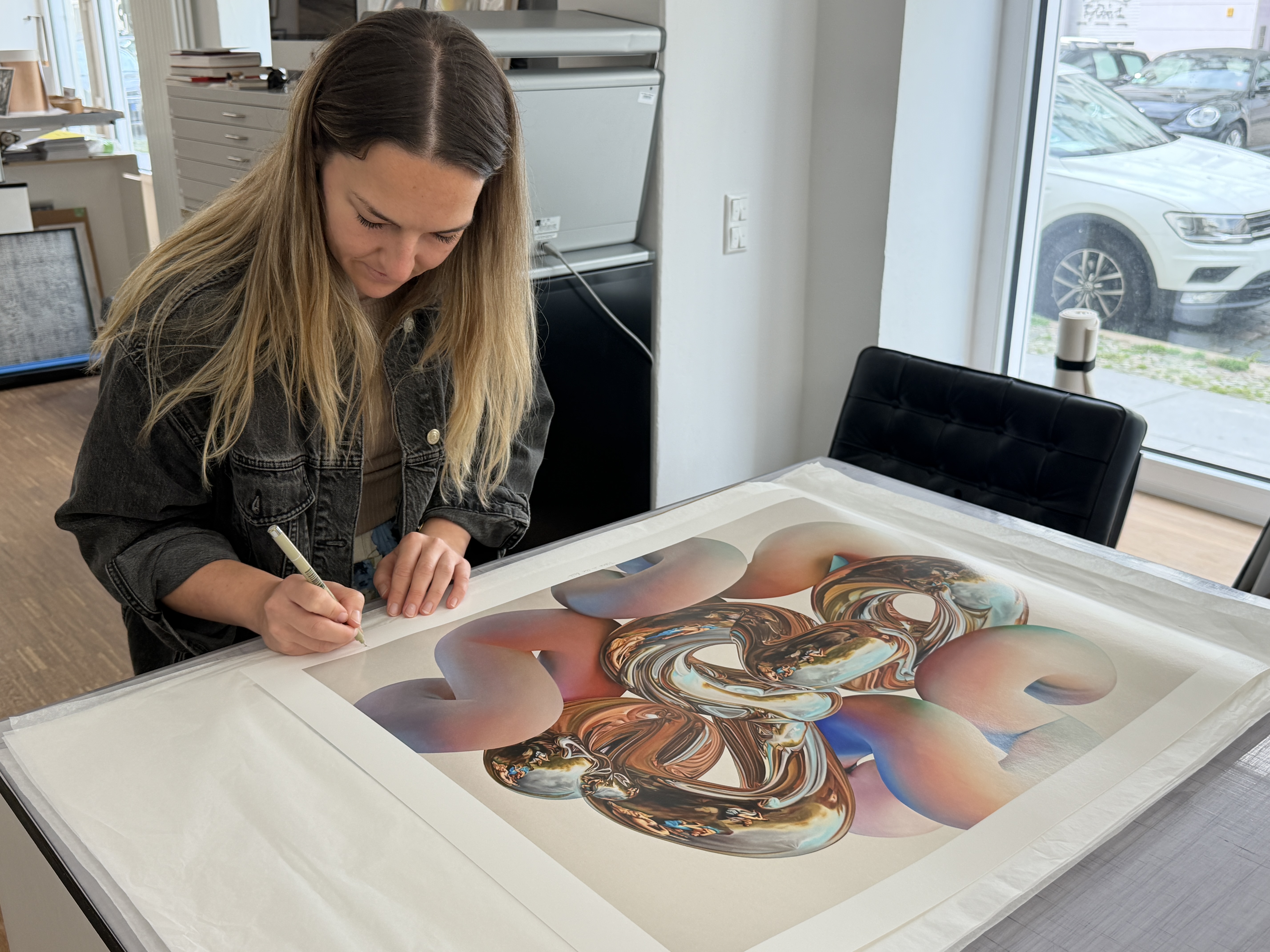
Vickie Vainionpää
Diana in the Bath, 2026
Signed archival pigment print on Hähnemuhle paper
60 x 75 cm (23 5/8 x 29 1/2 in)
Edition of 35
€650 excl. VAT where applicable
On the occasion of Vickie Vainionpää’s solo exhibition Spectral, Future Gallery is pleased to release Diana in the Bath, a new archival pigment print produced in a limited edition of just 35.
Diana in the Bath belongs to Vainionpää’s ongoing Gaze Paintings series, in which she uses eye-tracking technology to record her own gaze while looking at historical paintings. This visual data becomes the starting point for each composition, translating the act of looking into the fluid, abstract forms characteristic of her paintings.
The series considers the relationship between vision, technology and art history, particularly in relation to historical representations of the female body and the tradition of the male gaze.
Diana in the Bath takes as its point of departure Dirck van der Lisse’s 1635 painting of the same subject, which hangs in Berlin’s Gemäldegalerie, directly across from the gallery. Vainionpää’s painting is currently on view in Spectral, creating a direct connection between the historical source, the artist’s gaze and this limited-edition release.


