Kévin Bray: Now the Stars Are Looking Back at Us
-
 Kévin Bray, A Galaxy of Gaze, 2026
 -
Kévin Bray, The shooting star, 2026
-
Kévin Bray, Their most intimate spy, 2026
-
Kévin Bray, Constellations and Contagions, 2026

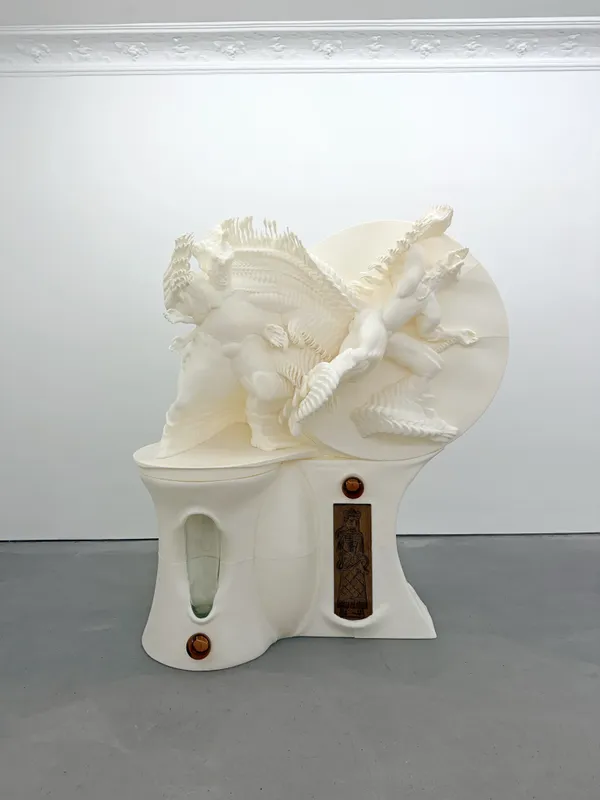


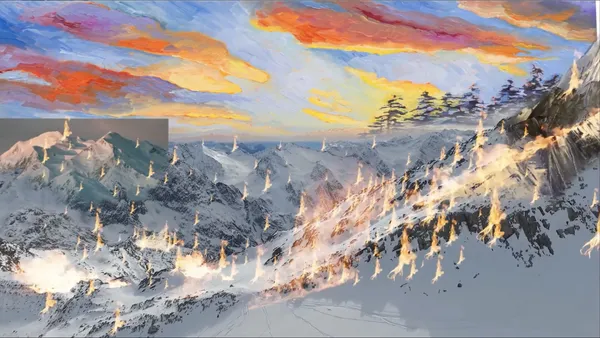
The second solo show by Kévin Bray at Future Gallery functions as the conceptual research for a larger narrative project titled One’s Story. The exhibition, Now the Stars Are Looking Back at Us, analyzes a fundamental inversion of the human gaze. For most of history, tracking was an active way of looking at the world, a manual process of following stars, animals and seasons to survive. Today, that relationship has been radically re-engineered. Tracking has evolved from a visceral engagement with the environment into a global, automated architecture of extraction. The sky is no longer a map for human navigation, it is a high-altitude grid for the mass-observation of the human subject. The celestial bodies that once guided us have been replaced by an orbital blanket of human-made "stars", a dense layer of satellites and sensors designed to look back, down, and through us.
The traditional image of surveillance is the Panopticon popularized by Michel Foucault: a dark, central watchtower. Bray argues, however, that the contemporary "vertical gaze" of satellites and screens operates through the logic of a disco ball. It is a central, rotating object that captures the light of our data only to fragment, multiply, and scatter it back at us.
This new Panopticon is seductive: it is shiny, rhythmic, and high-frequency. Yet, like the disco ball, it is also strategically blinding. By breaking reality into thousands of reflected facets, it prevents a cohesive view of the system itself. We are mesmerized by the "sparkle" of real-time connectivity, but this very brightness obscures the underlying machinery of control, leaving us unable to see the void of space or the clarity of the horizon.
In this realm, the word "star" has been severed from its astronomical origins and repurposed through a process of starification. Our collective curiosity has been redirected away from the infinite and toward the individual. We have populated a new constellation of "human stars", celebrities, icons, and influencers whose movements are tracked with an extractive, algorithmic intensity. This is the social side of the disco ball: a world where being "in the light" is the ultimate currency, even if that light functions as a tool of total transparency and management.
As we populate low-Earth orbit with thousands of artificial satellites, we are participating in a physical erasure of the universe. Scientists warn that within decades, the 'real' stars may become invisible, obscured by a cloud of human-made light and orbital debris. This shift effectively transforms the Earth into a planetary disco ball: a faceted sphere of metallic mirrors that reflects our own signals back at us, encasing the globe in a shell of permanent self-observation. We are replacing the deep time of the universe with the real-time of the network.
The work distinguishes between two competing modes of reading the world: Ecological Literacy and Algorithmic Literacy. The former, defined as an "Inquisitive Gaze," is an empirical, sensory-driven mode of tracking rooted in the curiosity to decipher the "neighbor": animal, plant, or planet, through a direct, tactical intimacy where knowledge is a mutual, if difficult, dialogue between the observer and the observed. In contrast, Algorithmic Literacy operates as a "Predictive Gaze," a systemic evolution that shifts the focus from presence to abstraction by flattening the unpredictable movements of life into standardized, actionable data points. Within this framework, curiosity is supplanted by optimization; the "neighbor" is no longer a mystery to be wondered at, but a user profile to be managed, policed, and monetized. This represents the final transition of tracking into a one-way extraction, an automated process of observation conducted from the safe, sterile, and increasingly remote distance of the sky.
Where we once tracked the stars to understand our place in the world, we now track humans to manipulate behaviors and emotions. Through sculpture and installation, this exhibition materializes these invisible signals, asking what remains of human agency when the navigator’s intuition is fully replaced by the data-broker’s algorithm.
